
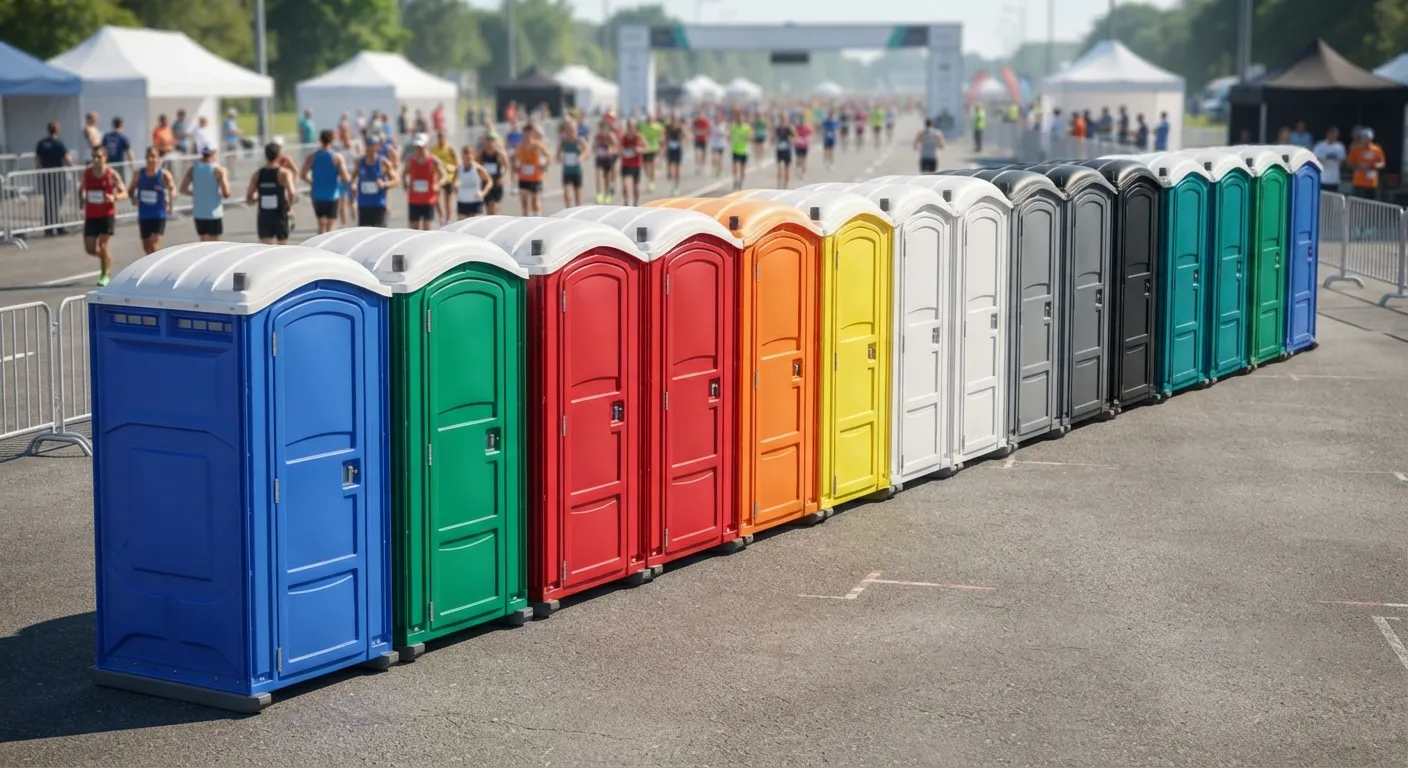
How many restrooms does a race need?
Start with the crowd, not the course. A standard unit runs $100 to $350 a day depending on volume, and for a one-day race that daily rate usually beats a weekly hold. Races with 500 to 1,000 runners typically cluster 4 to 6 units at the start/finish and space 1 to 2 units every couple of miles along the route, wherever a road crosses or an aid station sits. That spacing matters more than the total count. Runners will not detour 300 yards for a toilet mid-race, so placement planning has to follow the course elevation and road access, not just a headcount formula.
ADA compliance is not optional for a permitted public event. ADA Standards section 213.2 requires at least 5 percent of a cluster to be accessible units, never fewer than one, and the unit itself needs a 60 inch turning circle inside per ADA Standards 304.3.1. If your finish festival in Redlands draws a wheelchair division or spectators with mobility needs, that accessible unit belongs at the start line and the finish line both, not just one end of the course.
Crews and volunteers count separately from spectators. If you have staff working the course under general labor rules, OSHA 1926.51(c) sets the construction-site ratio at 1 toilet per 20 workers for crews of 20 or fewer, scaling up from there. That is a different math problem than spectator counts, and race organizers who mix the two under-provision one side or over-provision the other.
What does a race day restroom setup cost?
Pricing depends on unit type, count, and whether you need a same-day swap mid-race. Here is what a typical Redlands race weekend runs against the standard bands.
| Item | Day rate | Notes |
|---|---|---|
| Standard unit | $100 - $350 | per-unit day pricing |
| ADA accessible unit | $200 - $400 | required at 5% of cluster minimum |
| Deluxe flushable unit | $85 - $1,200 | for VIP or sponsor tents |
| Delivery fee | $100 - $500 | one-time, per drop |
| Service fee | $100 - $300 | mid-event servicing if needed |
Most race organizers in Redlands book a mix: standard units along the course, one or two ADA accessible units at the start/finish, and a couple of deluxe flushable units near any VIP or sponsor area. If your finish festival runs into a second day, ask about event-length pricing rather than booking day rates twice. A full cost breakdown is worth a look before you finalize your budget line for sanitation, since it is often underestimated against fencing and barrier costs.
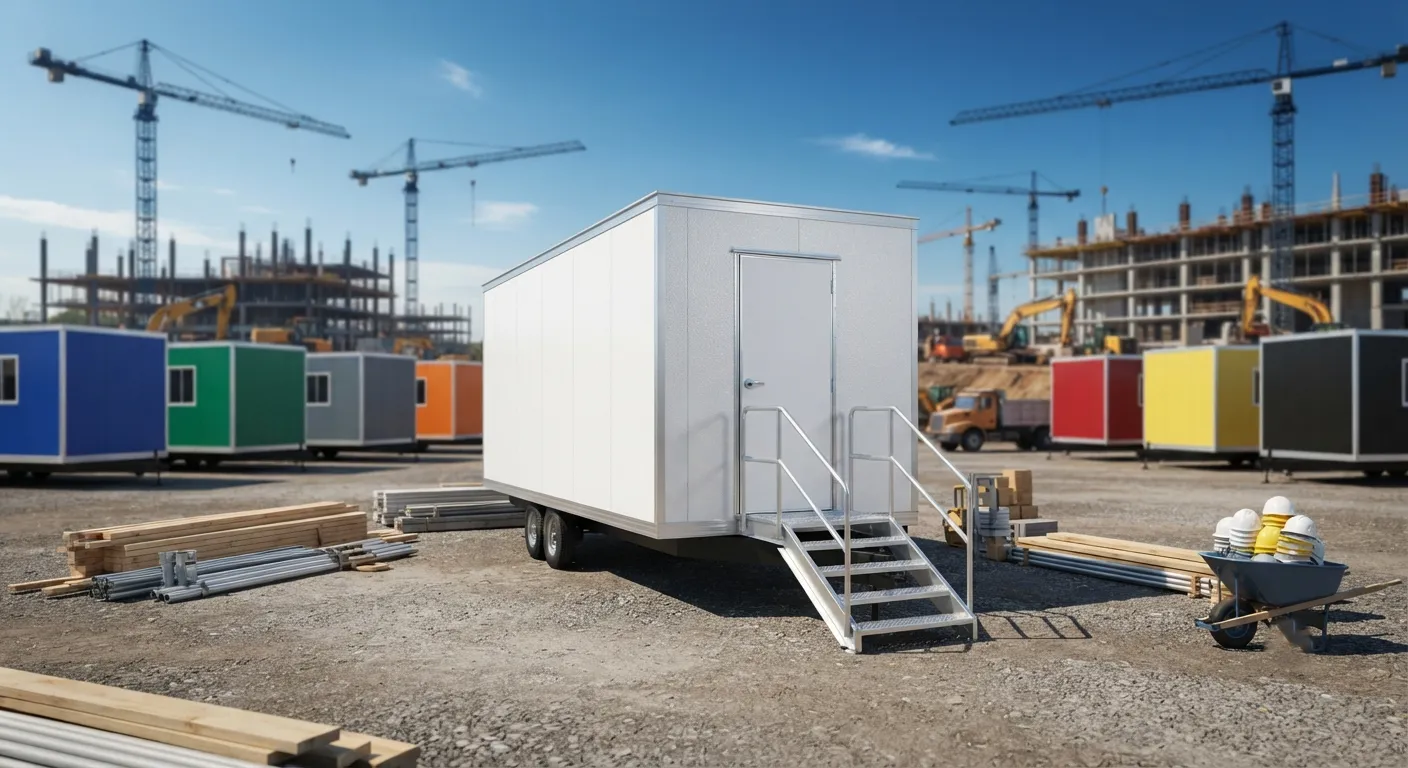
Delivery access matters here too. A roll-off delivery or a restroom trailer drop needs about 60 feet of straight clearance behind the truck, which most finish-line festival grounds can accommodate, but narrow park roads or trailhead lots sometimes cannot. Flag that during your site walk, not the morning of the race.
Where should restrooms go along the course?
Put them at the start, the finish, every aid station, and any point where the course crosses a public road. That last one matters for temporary fence rental and crowd control barrier placement too, since restrooms often sit right next to the barrier line where runners funnel through. Loma Linda is 5.3 miles west of Redlands and Highland sits 5.9 miles north, so if your course crosses into either jurisdiction, the placement and any permit needs get confirmed per city; check with the city rather than assuming Redlands rules carry over the line.
If your race uses a generator-powered timing tent or a lit finish arch, you likely also need a temporary power pole. Race crews often ask how to brace a temporary power pole on soft turf or gravel: set a base plate under it and run guy wires out to three anchor points, keep the cable run clear of the runner corridor, and route it away from any restroom service path so the pump truck still has a clean approach. A light tower at the finish line, if your race runs into early morning hours, needs the same clearance planning.
Handwashing stations belong near any food or medical tent. Under 29 CFR 1910.141(d)(2), any washing facility needs soap and towels or a hand-drying device, since sanitizer alone does not satisfy that standard, so budget a real handwashing station or portable sink rather than a sanitizer stand alone for medical tents.
How far in advance should I book race restrooms?
Book as soon as your course map and permit are set, ideally 4 to 6 weeks out for a race the size of most Redlands events. Units get tight during peak race season, and last-minute orders often mean fewer accessible units available. A quote request locks your count early.
Do I need a permit for restrooms placed in a public right of way?
Placement in the public right of way needs confirming with the city of Redlands directly; permit rules vary by street and by event size, so check current permit requirements before finalizing your course map rather than assuming last year's approval carries over.
Can I get restrooms serviced mid-race?
Yes, for longer events or multi-day festivals a mid-event service visit keeps units usable through the finish. Ask about a service fee add-on when you book, since race-day servicing runs on a tighter window than routine weekly service.
What is the difference between a standard unit and a deluxe unit for a race?
A standard unit is a basic 60 to 70 gallon tank unit, fine for course-side placement. A deluxe flushable unit adds a flush mechanism and interior finish, better suited to VIP tents or sponsor areas near the finish festival.
How many accessible units do I need for a 1,000-runner race?
At minimum, 5 percent of your total cluster under ADA Standards 213.2, and never fewer than one. For a typical 5 to 6 unit deployment, that means at least one dedicated ADA accessible unit at the start/finish area.
Next step
Get a delivery date
Tell us the address, the dates and the headcount. We size the order and confirm the route.